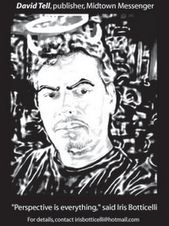
I go there in my mind
I just read a column in another local publication, titled “There’s no way that just happened!” This was a religion column, and — beyond a number of the doctrinal and hortatory points it made — one of the notable things about it was the number of words printed in all capital letters. (Now, I’m sure this was completely intentional. We sometimes hear the advice as to e-mail etiquette, “Don’t type in all caps, it looks like you’re yelling.” Here, I’m sure that was the intended effect: This pastor was writing as if delivering a sermon, and at various points in that sermon, I know he would be rather worked up and joyously enthusiastic, and he wanted you to feel that, even while reading quietly to yourself. And I did feel it.)
The other thing notable about his column, though, is that, starting with its title, it takes the opposite view from the one in an essay I recently wrote for my evangelical Jewish friend, who lives in Washington. D.C. Yes, you heard me, this is a right-wing, evangelical Jew (no, not a “messianic Jew,” not one of those so-called “Jews for Jesus”). He’s an avid supporter of “intelligent design,” and of President Bush, along with all of his policies (except his refusing to veto excessive spending). He’s also virulently anti-“choice,” considers Jack Abramoff an upstanding fellow, says liberals and the New York Times are all a bunch of liars promoting a radically secular agenda, etc., etc.
He and I have been arguing over a number of these issues, especially evolution, ID and scientific vs. Biblical explanations for things, via e-mail for about 5 years now.
Side note: Interestingly, this friend and I go back to the 7th grade, and in that era, there was no particular clue he would turn out to be a right-wing wacko. Within certain margins, he seemed quite normal, including being normally rebellious. He introduced me to some good rock albums when I first joined a record club. He also sold me his electric guitar. In the 8th grade, we got sent to the principal’s office for gambling on the school bus. (We were just playing gin and Ohell, for a half-cent a point. Is that gambling?! I ask you.) We tried growing pot out at his once-reprobate-bachelor Dad’s old babe-lair cabin in the woods … just to name a few mutual, harmless adolescent exploits. (Actually, speaking of pastors, visiting him at college once, a preacher’s daughter seduced me at a frat party. Dating her later, I took her out to said cabin one weekend. “David, is this wrong?” she drawled, apparently in shock at the now non-drunken, premeditated brazenness of our trysting.)
Back to bizness. Well, I had a brainstorm recently and figured I might finally be able to explain the correctness of evolution to my old friend — to everyone, in fact — in simple, easy-to-understand terms. Like the reverend’s column I just read, it has to do with what’s more likely: improbable things happening by blind, random chance, or, alternatively, “on purpose”? The idea is so easy, so universally comprehensible, I even sent it to Newsweek as a “My Turn” column. Still waiting to hear back on that. In the meantime, I offer it here, where lesser renown and notoriety, or even pillorying may await me:
The proof is now available. Kind of like with profound mathematical and physics theories, I can now prove the veracity of evolution and the falsity of intelligent design “theory” by way of a thought experiment.
In doing this, I think I am emulating the ID proponents. They construct thought experiments that “prove” ID by showing it defies common sense to think certain things in nature could happen by chance; therefore they must have come about due to an underlying, purposeful mind--probably God, but who knows? It could be those aliens who left the monoliths around littering the solar system, in order to further our evolution from dumb, doomed australopithecines to aggressive, therefore thriving, hominids (and beyond!).
Now, in response, scientists tend to come up with points that get around the IDers’ objections to evolution. I’m not going to go into those back-and-forths. I will instead comment on how philosophers of science--and without having to know much actual science either--can also identify the fallacies in IDers’ thinking, at a more fundamental level.
For instance, a few months ago, one of those liberal-secular New York Times contributors pointed out that one reason ID seems appealing as an explanation is because people basically have trouble truly grasping the immensity of time and space--and, I would add, the amazingly fertile hubbub in the realm of the very small and fast. In other words, if people other than cosmologists, subatomic physicists, geologists, microbiologists and so on could really get their heads around how zillions of events (most of them leading to nothing much interesting), over huge spans of time, at a minuscule, frantic scale and pace could and have led and do lead to all observable natural phenomena (even the most complex and autonomous, such as most “higher” animals, and many people), they would have much less problem allowing the explanatory power of evolution.
By contrast, since many people have very little imagination concerning scientific concepts, and limited ability to hold several abstractions in mind long enough to connect them into an intellectual framework, they think a number of what I consider superstitious, pseudo-explanations for things are more likely, and simpler. But pushing the question of complexity back one step to a Mind capable of coming up with nature’s forms and processes doesn’t really explain anything, even if it might perchance be true. That’s probably why the Founding Fathers were Deists, if by it they meant that a God may be the “First Mover,” but the way in which it then all works out over the eons is a fascinating subject for scientific inquiry, not faith-based nostrums. (Nate also disputes what he calls the “propaganda” that says the Founders were Deists and promoted “separation of church and state.” Oy vey, vas ist dis mishugahss?)
So, back to my thought experiment:
I have a concept called, “Couldn’t have done that if you tried.” [Editor’s note: See, there’s the contrast with the pastor’s title, “There’s no way that just happened.”] You know, like when you toss a piece of trash at the wastebasket and it happens to perch precariously on the edge, just barely teetering there (maybe with the help of the wall--but it’s still pretty cool, and highly unlikely). Or something else, say a slightly crumpled envelope, playing card or piece of a box, or a dollar bill (or, for the less flush, a quarter): you toss it or drop it, and it lands--and stands or leans--on its side or in the slot in a way that you could never have achieved in a million years if you were trying. I’m sure everyone can come up with their own examples. (Many of mine have to do with throwing something and it balancing improbably somehow--must be my inferiority complex about how I’ve never been able to get a basketball anywhere near the basket, let alone propped on the rim, against the backboard. By contrast, my old friend was pretty good with a ball, and still has a nickname associated with some player named Hal _____, number 15 …)
But I digress (again). The bottom line is, my thought experiment (really more just a notion, actually) proves that evolution is correct. The most amazing things happen by chance, more amazing than what tends to happen by design, and the more amazing, the more likely it is that it couldn’t have happened “on purpose.” (OK, so it’s just a variation on the old saw, “Truth is stranger than fiction.”)
Same for evolution: Only chance could account for all the amazing occurrences that have led to all the complex and bizarre forms we know in nature. Such as Michael Jackson. (Ta-dum.) No way anyone--even a God, or a super-brainy and unaccountably benevolent alien--could have done it all on purpose. That would defy the odds, for sure.
So, now you’ve been given some exposure to simple, common-sense based, easy-to-understand formulas for the opposing viewpoints on a major issue of our time. Which side do you come down on? Let us know.
— Or, maybe, you happen to have landed kind of on edge, improbably balanced on an ear, shoulder and hip-bone, not even immediately apt to fall over one way or the other. But if you write to tell me about it, I have only one request: Avoid all-capital-letters.
THANKS!!!
--David Tell
© 2006 Quicksilver Publishing Group. All rights reserved.
Wednesday, November 29, 2006


From our Nov. 20 print issue: Encanto historic designation controversy doesn't deter Council
Council OKs Encanto HD extension
Overrules citizen planners, to match National Historic Register boundary for area
By David Tell, Messenger Editor
© 2006 Quicksilver Publishing Group. All rights reserved.
Following two seeming setbacks, the proposed historic zoning overlay for an additional area of the Encanto-Palmcroft neighborhood was approved by City Council on Nov. 1.
The proposal affected a set of vintage “garden apartments” at 1302 W. McDowell as well as current and former single family homes between 11th and 13th avenues along the north side of McDowell Road. It was voted down by the Encanto Village Planning Committee and city Planning Commission, which are citizens advisory bodies whose decisions are not binding on Council.
The proposal has been controversial in and beyond the neighborhood, largely due to a proposed upscale condo project that would be built in place of the apartments, which had been a crime and blight nuisance to adjacent residents, requiring regular police attention.
The overlay, which would extend the city’s protective historic zoning to match that of the National Register of Historic Places’ more honorific boundaries for the district, imposes a one-year moratorium on any demolition and requires an approved plan for any replacement structures, in order to harmonize development with the adjacent historic homes. Adjacent residents also included in the overlay opposed it for fear that the problem apartment property would continue to languish.
Opponents have also objected to the unusual means by which the overlay was initiated—at the suggestion of Council’s Housing Neighborhoods and Historic Preservation subcommittee last spring and then by the full Council—rather than originating with the Historic Preservation Commission. However, city HP Officer Barbara Stocklin has pointed out that ordinance allows for that route of initiation, as well as other paths for an overlay proposal. In addition, while the commission has a policy of requiring 75 percent owner support to initiate an overlay, it is not bound by that policy, nor is Council.
Nonetheless, apartments property owner Scott Haskins, a California developer and art conservator, said the overlay approval is “disappointing,” and that he is evaluating all legal options for overturning Council’s decision.
“City Council’s basis for evaluating the situation comes from a completely different direction than the village planning committee or the Planning Commission,” Haskins said. “The Encanto Village Planning Committee looks at the benefits to the village and at issues relative to property rights. The Planning Commission looks at property rights and development in the city and considers also legal issues that they feel are important to planning issues. City Council looks at it from a political point of view: ‘Who needs what and who is going to vote with whom?’ Council refused to recognize the validity of the opinions of those other two bodies,” Haskins said. “And the Council completely ignored the preponderance of opinion of the neighborhood. The neighborhood was overwhelmingly opposed.
“Council ignored all that,” Haskins said. “Their issue is heightened with the passing of Prop 207. 207 underlines the issue in the neighborhood. According to City Council, it is handing over my project to HP. HP doesn’t have any development guidelines, only an arbitrary loosey-goosey guidance they would like to attempt to impose or oversee the project with. If they listened to the minority neighborhood activists, the property is going to be only two stories tall and a lot less units. That’s half the value. Council said ‘We don’t care about the R-5 zoning and the property rights, we’re going to rezone it.’ Or attempt to.”
Haskins’ plans are for four-story structures.
Proposition 207 is a citizens initiative passed in Arizona, as in several other states, a couple weeks ago, promulgated by property rights activists in the wake of the Supreme Court’s controversial “Kelo” eminent domain decision last year. It allows people to sue governments for land use actions they believe have diminished their property’s value.
Whether Haskins could sue under the new law, given that his property was rezoned before Prop. 207 was passed by voters, is not clear. Larry Felix, an attorney in the city’s Law Department, said for a law to be able to be applied retroactively, it usually has to explicitly state that is is intended to so apply.
“My project should be the poster boy for 207,” Haskins said. “There’s a question about that [its applicability to his case]. The city vote doesn’t go into effect for 30 days. Of course I’m having my attorney look into that. City Council has to go back over their resolutions and vote them into play.”
However, Haskins’ timetable could be confounded by the fact that the clock also doesn’t start ticking on Prop. 207’s effective date until after the public vote has been “canvassed” and then certified by the governor, a process that also tends to take several weeks.
Haskins said there could be a whole host of legal issues giving him opportunity to overturn the rezoning. As an example, “We believe the city submitted the whole proposal improperly or illegally,” he said. “Statutes say for City Council to put into motion a historic overlay the way they did, it requires the signature of at least one property owner—which they did not get. There are three or four or five [other possible legal] points.”
In addition, Haskins, who has retained not only local attorneys on his behalf, is also working with Choice Zoning Group, a firm specializing in community relations related to land use issues. The Midtown Messenger has been told it is formerly owned by District 5 Councilman Claude Mattox, who sold it to Robert Rakowski. Whether or not connected to Choice Zoning’s efforts, a column by Laurie Roberts in the Arizona Republic in September characterized apartments as “garbage,” not historic; and a local radio talk show reportedly used the case recently as a take-off for a wider harangue about property rights. Mattox and District 8 Councilman Mike Johnson were the two “no” votes on the overlay, vs. five in favor. District 2 Councilwoman Peggy Neely was off the dais.
Haskins feels his case touches a public nerve more broadly in Phoenix.
“I’m in the process of initiating a referendum,” he said. “We believe City Council has acted improperly and not in the best interest of property rights. We believe this is an issue the city [populace] would like to know more about and vote on.”
Haskins seems to have in mind a referendum effort seeking to overturn Council’s decision in a citywide election, similar to when Biltmore area neighborhood groups and others mounted a challenge to Council’s raising the height limitations for the area of 24th Street and Camelback to accommodate developers’ plans for the area.
Haskins was asked about longtime Fairview Place resident Marge McCue’s comments in the October Midtown Messenger that his apartment plans seem “pie-in-the-sky” and his projected value per square foot seems unrealistic. Her remarks were based on a presentation of his plans made at Encanto Clubhouse at Encanto Park in September.
“She’s not a developer,” he retorted. “If you’ve got comments from other developers and people who invest their money in the improvement of a city, I’ll be glad to listen. I can get opinions all day from people who don’t know squat.”
Asked whether it is specially advantageous for him to be developing property in Arizona, where Prop 207 has passed, rather than in California, where a similar initiative failed, Haskins replied, “I don’t know if there’s any benefit [to being a California developer investing in Arizona], but the ‘Socialist Republic of California’ would of course follow that path. California sides with the rights of the renters. They pass all these social programs, add all the taxes to the businesses. There’s a completely different social atmosphere in California.”
Encanto-Palmcroft resident G.G. George heads the Encanto Citizens Association, through which she has fought for the neighborhood’s historic status and other issues for decades. Critics attribute the initiation and passage of the overlay at least partly to her connection with District 7 Councilman Doug Lingner, who represents the area, as well as most of the areas containing the city’s residential historic districts. Of the latest outcome, “I’m very pleased that the Council saw the precedent, the policy that the city has established and of course the value to Palmcroft of those historic apartments,” George said. “The Encanto Citizens Association’s official position is that the mayor and Council acted correctly to align our Phoenix Property Registry boundaries with the National Register boundaries.”
The apartments in the overlay area have been identified by the HP Office as historically significant, as “first-generation buildings on land that was part of the original Palmcroft plat.” Other, similar “garden apartment” complexes have been preserved for reuse, and—in Scottsdale, for instance—are specifically being documented for designation as a significant historic style of their era.
Haskins’ pending hardship appeal of the previous denial of a demolition permit for the apartments has been canceled, as moot under the rezoning. “If he wants to file demolition economic hardship request, he will have to start over again,” Stocklin said. “There’s a separate process for filing under the ordinance, given that the HP zoning is now no longer pending but is permanent.” Haskins, asked whether he would pursue that route parallel to his other efforts, said he hadn’t decided.
In addition “There is the possibility of the property owners filing a ‘regulatory takings’ claim, within 30 days of when City Council approved the minutes from the meeting when the action was taken,” Stocklin said. “We hear that they’re planning on filing one.” She said there was a regulatory takings claim filed a few years ago in a Garfield neighborhood case. It is unclear whether that is one of the avenues Haskins was referring to among his legal options, or an additional one.
According to attorney Felix, a regulatory takings case has long been a possible legal remedy, but he said success in bringing a claim tends to require a showing that a regulatory action reduced a property’s value to zero, or at least to a merely nominal value.
Overrules citizen planners, to match National Historic Register boundary for area
By David Tell, Messenger Editor
© 2006 Quicksilver Publishing Group. All rights reserved.
Following two seeming setbacks, the proposed historic zoning overlay for an additional area of the Encanto-Palmcroft neighborhood was approved by City Council on Nov. 1.
The proposal affected a set of vintage “garden apartments” at 1302 W. McDowell as well as current and former single family homes between 11th and 13th avenues along the north side of McDowell Road. It was voted down by the Encanto Village Planning Committee and city Planning Commission, which are citizens advisory bodies whose decisions are not binding on Council.
The proposal has been controversial in and beyond the neighborhood, largely due to a proposed upscale condo project that would be built in place of the apartments, which had been a crime and blight nuisance to adjacent residents, requiring regular police attention.
The overlay, which would extend the city’s protective historic zoning to match that of the National Register of Historic Places’ more honorific boundaries for the district, imposes a one-year moratorium on any demolition and requires an approved plan for any replacement structures, in order to harmonize development with the adjacent historic homes. Adjacent residents also included in the overlay opposed it for fear that the problem apartment property would continue to languish.
Opponents have also objected to the unusual means by which the overlay was initiated—at the suggestion of Council’s Housing Neighborhoods and Historic Preservation subcommittee last spring and then by the full Council—rather than originating with the Historic Preservation Commission. However, city HP Officer Barbara Stocklin has pointed out that ordinance allows for that route of initiation, as well as other paths for an overlay proposal. In addition, while the commission has a policy of requiring 75 percent owner support to initiate an overlay, it is not bound by that policy, nor is Council.
Nonetheless, apartments property owner Scott Haskins, a California developer and art conservator, said the overlay approval is “disappointing,” and that he is evaluating all legal options for overturning Council’s decision.
“City Council’s basis for evaluating the situation comes from a completely different direction than the village planning committee or the Planning Commission,” Haskins said. “The Encanto Village Planning Committee looks at the benefits to the village and at issues relative to property rights. The Planning Commission looks at property rights and development in the city and considers also legal issues that they feel are important to planning issues. City Council looks at it from a political point of view: ‘Who needs what and who is going to vote with whom?’ Council refused to recognize the validity of the opinions of those other two bodies,” Haskins said. “And the Council completely ignored the preponderance of opinion of the neighborhood. The neighborhood was overwhelmingly opposed.
“Council ignored all that,” Haskins said. “Their issue is heightened with the passing of Prop 207. 207 underlines the issue in the neighborhood. According to City Council, it is handing over my project to HP. HP doesn’t have any development guidelines, only an arbitrary loosey-goosey guidance they would like to attempt to impose or oversee the project with. If they listened to the minority neighborhood activists, the property is going to be only two stories tall and a lot less units. That’s half the value. Council said ‘We don’t care about the R-5 zoning and the property rights, we’re going to rezone it.’ Or attempt to.”
Haskins’ plans are for four-story structures.
Proposition 207 is a citizens initiative passed in Arizona, as in several other states, a couple weeks ago, promulgated by property rights activists in the wake of the Supreme Court’s controversial “Kelo” eminent domain decision last year. It allows people to sue governments for land use actions they believe have diminished their property’s value.
Whether Haskins could sue under the new law, given that his property was rezoned before Prop. 207 was passed by voters, is not clear. Larry Felix, an attorney in the city’s Law Department, said for a law to be able to be applied retroactively, it usually has to explicitly state that is is intended to so apply.
“My project should be the poster boy for 207,” Haskins said. “There’s a question about that [its applicability to his case]. The city vote doesn’t go into effect for 30 days. Of course I’m having my attorney look into that. City Council has to go back over their resolutions and vote them into play.”
However, Haskins’ timetable could be confounded by the fact that the clock also doesn’t start ticking on Prop. 207’s effective date until after the public vote has been “canvassed” and then certified by the governor, a process that also tends to take several weeks.
Haskins said there could be a whole host of legal issues giving him opportunity to overturn the rezoning. As an example, “We believe the city submitted the whole proposal improperly or illegally,” he said. “Statutes say for City Council to put into motion a historic overlay the way they did, it requires the signature of at least one property owner—which they did not get. There are three or four or five [other possible legal] points.”
In addition, Haskins, who has retained not only local attorneys on his behalf, is also working with Choice Zoning Group, a firm specializing in community relations related to land use issues. The Midtown Messenger has been told it is formerly owned by District 5 Councilman Claude Mattox, who sold it to Robert Rakowski. Whether or not connected to Choice Zoning’s efforts, a column by Laurie Roberts in the Arizona Republic in September characterized apartments as “garbage,” not historic; and a local radio talk show reportedly used the case recently as a take-off for a wider harangue about property rights. Mattox and District 8 Councilman Mike Johnson were the two “no” votes on the overlay, vs. five in favor. District 2 Councilwoman Peggy Neely was off the dais.
Haskins feels his case touches a public nerve more broadly in Phoenix.
“I’m in the process of initiating a referendum,” he said. “We believe City Council has acted improperly and not in the best interest of property rights. We believe this is an issue the city [populace] would like to know more about and vote on.”
Haskins seems to have in mind a referendum effort seeking to overturn Council’s decision in a citywide election, similar to when Biltmore area neighborhood groups and others mounted a challenge to Council’s raising the height limitations for the area of 24th Street and Camelback to accommodate developers’ plans for the area.
Haskins was asked about longtime Fairview Place resident Marge McCue’s comments in the October Midtown Messenger that his apartment plans seem “pie-in-the-sky” and his projected value per square foot seems unrealistic. Her remarks were based on a presentation of his plans made at Encanto Clubhouse at Encanto Park in September.
“She’s not a developer,” he retorted. “If you’ve got comments from other developers and people who invest their money in the improvement of a city, I’ll be glad to listen. I can get opinions all day from people who don’t know squat.”
Asked whether it is specially advantageous for him to be developing property in Arizona, where Prop 207 has passed, rather than in California, where a similar initiative failed, Haskins replied, “I don’t know if there’s any benefit [to being a California developer investing in Arizona], but the ‘Socialist Republic of California’ would of course follow that path. California sides with the rights of the renters. They pass all these social programs, add all the taxes to the businesses. There’s a completely different social atmosphere in California.”
Encanto-Palmcroft resident G.G. George heads the Encanto Citizens Association, through which she has fought for the neighborhood’s historic status and other issues for decades. Critics attribute the initiation and passage of the overlay at least partly to her connection with District 7 Councilman Doug Lingner, who represents the area, as well as most of the areas containing the city’s residential historic districts. Of the latest outcome, “I’m very pleased that the Council saw the precedent, the policy that the city has established and of course the value to Palmcroft of those historic apartments,” George said. “The Encanto Citizens Association’s official position is that the mayor and Council acted correctly to align our Phoenix Property Registry boundaries with the National Register boundaries.”
The apartments in the overlay area have been identified by the HP Office as historically significant, as “first-generation buildings on land that was part of the original Palmcroft plat.” Other, similar “garden apartment” complexes have been preserved for reuse, and—in Scottsdale, for instance—are specifically being documented for designation as a significant historic style of their era.
Haskins’ pending hardship appeal of the previous denial of a demolition permit for the apartments has been canceled, as moot under the rezoning. “If he wants to file demolition economic hardship request, he will have to start over again,” Stocklin said. “There’s a separate process for filing under the ordinance, given that the HP zoning is now no longer pending but is permanent.” Haskins, asked whether he would pursue that route parallel to his other efforts, said he hadn’t decided.
In addition “There is the possibility of the property owners filing a ‘regulatory takings’ claim, within 30 days of when City Council approved the minutes from the meeting when the action was taken,” Stocklin said. “We hear that they’re planning on filing one.” She said there was a regulatory takings claim filed a few years ago in a Garfield neighborhood case. It is unclear whether that is one of the avenues Haskins was referring to among his legal options, or an additional one.
According to attorney Felix, a regulatory takings case has long been a possible legal remedy, but he said success in bringing a claim tends to require a showing that a regulatory action reduced a property’s value to zero, or at least to a merely nominal value.
HP Commission initiates Oakland 'Triangle' zoning overlay
On Nov. 20, the city's Historic Preservation Commission formally initiated the historic designation process for the so-called Triangle area of the Oakland/University Park neighborhood. Bounded roughly by Roosevelt Street, 7th Avenue and Grand Avenue, the proposed historic addition includes 100 buildings. Sixty property owners submitted petitions supporting the initiation; 24 owners opposed it; 16 had not responded by the hearing. The action means a stay of demolition will be in effect for the area as the proposal goes before the remaining public bodies that must weigh in on it. For a complete update, look for the Dec. 18 issue of The Midtown Messenger.
Gibson's 'Apocalypto': Stay tuned ...
Opening Dec. 8, this much anticipated release from the troubled but prominent actor/filmmaker is indeed worthy of the hype--if you don't mind watching a bunch of aboriginals running around above subtitles. To prepare to better understand this film (and our review, to come), pick up and read a copy of Daniel Quinn's "novel" Ishmael this week.
Sun Merc Update: No update yet!
Downtown Voices Coalition secretary Beatrice Moore lets the community know: No ruling from the judge yet out of October 2 oral arguments.
Superior Court Judge Peter heard defendant's motion to dismiss and plaintiff's motion for summary judgment in the suit, which charges that Council acted contrary to ordinance and without sufficient authority when it approved development plans for the historic Chinese-America produce warehouse in December 2005. The plans call for an 11-story structure to be built atop the city-owned, historic designated warehouse, which is the last intact vestige of the city's former Chinatown. The city's Historic Preservation (HP) Office and HP Commission objected to the plans in the form the developer offered, but the agencies were overruled by the Council's vote. In a broadcast e-mail from Moore on Nov. 29, she exhibited patience with the judge, acknowledging that the wheels of justice grind exceedingly slowly.
Superior Court Judge Peter heard defendant's motion to dismiss and plaintiff's motion for summary judgment in the suit, which charges that Council acted contrary to ordinance and without sufficient authority when it approved development plans for the historic Chinese-America produce warehouse in December 2005. The plans call for an 11-story structure to be built atop the city-owned, historic designated warehouse, which is the last intact vestige of the city's former Chinatown. The city's Historic Preservation (HP) Office and HP Commission objected to the plans in the form the developer offered, but the agencies were overruled by the Council's vote. In a broadcast e-mail from Moore on Nov. 29, she exhibited patience with the judge, acknowledging that the wheels of justice grind exceedingly slowly.
Phoenix film critics debate new Aronofsky film
Avant garde filmmaker Darren Aronofsky releases his first film since "Requiem for a Dream." Read critic David Tell's series of takes and exchanges on what he feels is already a widely misunderstood film.
Upon viewing the advance screening:
I’m a pretty mystical guy, and I left the theater after seeing “The Fountain” almost identifying with the people who, nearly 40 years ago (wrongly) thought the latter third of “2001: A Space Odyssey” was a boring, inexplicable, pretentious head trip. The basis for the feeling, though, is that Darren Aronofsky’s latest film--his first since the awesome “Requiem for a Dream” six years ago--shares pacing, portentousness and psychedelic production design with the “trippy” adventure past the moons of Jupiter in “2001.” But looking at “The Fountain” from Marci’s probable perspective, I can see it’s really about love, joy, priorities, imagination, and how it really doesn’t matter whether we both fit in the tub together very well. Very few people are going to “get” this film, and they’re probably going to be pretty disappointed for the most part. Because, despite the billings, it’s not really about a conquistador who finds the “Tree of Life” (or Fountain of Youth) and lives to encounter his lady love again in a future age. That part of the story is analogous to the parallel literary plot in Neil Labute’s “Possession,” and, as in that film, the “real” story takes place in the present, and the other narrative reflects it to make a larger parable. In this case, it’s about not turning death into something it isn’t: either a release from the prison of the body or a disease to be conquered. It’s about life, and therefore about accepting death as an ending of our living connections with our loved ones. (“Eternal life,” in this context, is about being part of the eternal cycle of life, death and rebirth [though not as the same entity]--and acceptance of that reality.) And, as in “Possession,” “The Fountain,” putting things in context and prioritization, is cautionary about love: In that film, part of the point was that women ought not to over-idealize love at risk of exclusively feminizing it, leaving no real, authentic role and place for a man. Here, the point is that men’s’ tendency is to “practicalize” love, which tips it too far into the masculine realm and sensibility.
Response from a correspondent:
"The way you describe this it ALMOST sounds like a "chick" flick. That leaves me out! lol"
"Campaigning" message by David to fellow film critics after viewing a screener DVD of the film, a second look:
Phoenix Film Critics Society (PFCS) colleagues:
After re-viewing "The Fountain," as well as reading additional reviews, I am campaigning for it in a limited sense, convinced that Aronofsky is perhaps the closest current thing to a Kubrick heir, in at least two ways: the limited output and apparent careful crafting of the visual experience, and being widely misunderstood. (I.e., the possible pretentiousness and pseudo-profundity some people will find in the film.)
Even Joe Morgenstern of the Wall Street Journal in last Friday's edition succumbs to the red herring that the film, at its topmost narrative level, is about a man who lives across the centuries after finding the Tree of Life (or Fountain of Youth). My wife, viewing the screener (couldn't attend the press screening) also thought it was quite apparent that the "eternal life" thing is not what publicists and marketers are making it out to be--not even as a superficial understanding of "what happens" in the film.
Pretty clearly, the sole "real" story takes place in our present, with Tom as the cancer researcher and Izzy his wife dying of the brain tumor. Of the other two stories and incarnations of the characters, the "conquistador" one is simply the literary analog and subtext, underlining and explicating the themes of the present-day story. This is a little like the main story vs. the literary backstory in Neil LaBute's "Possession." Then, in the third aspect of the film, the Hugh Jackman character in the "snowglobe" is something like his spiritual self, undergoing psychic evolution after, presumably, having been killed by the Mayan guardian of the Tree of Life.
This latter, "spiritual" Hugh Jackman, in turn, serves as a metaphoric explication (and "completion") of Izzy's book, "The Fountain": In the present story, she has urged him to "finish it," and this phase of the film shows how he reaches that "ending": by evolving, even involuntarily, past an exploitative, self-serving understanding of what death is and what "life everlasting" really means, toward acquiescence in being part of the cycle of life, death and rebirth (though not as one's same conscious self: as part of the broader life-cycles of intertwined Nature). This "ending," this realization is also fulfilled in the present story by High Jackman dropping the sycamore seed ball (or whatever species of tree) into the ground over Izzy's grave.
I hate to expound and pontificate as if posting on an imDb message board (well, OK, no, I don't--it's what I do ...), but I feel ceasing to misunderstand this film so profoundly as many people are doing is essential to beginning to appreciate it. Like "2001: A Space Odyssey," it is a kind of masterpiece, even if not always a conventionally appealing and readily cognizable cinematic experience.
In this way I am hoping to help rescue it from being overlooked for whatever awards or accolades it may rightly be considered for.
Response from a fellow PFCS critic, who may remain anonymous unless she wishes otherwise:
It's an interesting argument regarding the meaning of the "snowglobe" parts of the film. But if this were only part of Izzy's fiction that Tom was completing, there is no explanation for the flashbacks and the visions of Izzy with him in the globe. Tom wouldn't have written those into the story to complete Izzy's book. And if the conquistador had truly been killed by the Mayan guardian, his body wouldn't have entered to find the tree of life; only his spiritual self would have been able to do that.
The evidence in the film suggests that it is indeed a future Tom in the "snowglobe". It is implied that his research went on to conquer death, which is why he is there in the future, travelling through space with a technology that we cannot imagine (what miracles of science could be discovered if the world's greatest minds didn't die off?). Further evidence that this is him and not part of the conquistador story is the fading tattoo around his ring finger, a marking which he creates shortly after Izzy's death. He then continues to tattoo his body to mark time, not unlike the rings of a tree, in parallel with his transfigured lover.
It also shows there is a spiritual side of Tom that has chosen to believe the parts of Izzy's conversation that suggest she might still live on through a tree planted over her grave. He takes pieces of her bark as a sacrament to keep this faith alive (a way of taking her inside him), and his destination is the dying star which she suggested was the place where life is reborn; although she accepted death, he is re-interpreting her tale of Mayan legend as a means of bringing her back to life as he remembered her.
I believe the point of the film is that the search for longevity is an unnecessary detour in the cycle of life, death, and rebirth.
Throughout the film we are wondering about that tree -- is it the actual tree of life, from which Tom was able to discover the secret of longevity? Or is it Izzy, transformed according to the story she told him earlier? I believe the answer to that is found at the end of the film, when Tom buries the seed in the snow above Izzy's grave. It is the only explanation for why that particular scene was placed AFTER the scene where Tom's future body was obliterated in the nebula.
At first it seemed ironic that only after Tom's death did the tree spring back into full bloom, but I think it was meant to illustrate that both Tom and Izzy were reborn within the tree in that instant.
David's response:
I am glad I have engaged you in a thoughtful exchange over this film. I don't presume to know you well, but I think I know you well enough to understand that I won't be able to change your thinking!
However, your points notwithstanding, I also still disagree. I suppose there could be evidence for both interpretations; however, I think mine requires fewer assumptions and less bending things in the film out of shape to make them fit.
In my interpretation, everything that happens after the Mayan guard swings his flaming sword at the conquistador should be taken as reflecting Tom's (decreasing?) misunderstanding of the issues surrounding life and death. His seeming to walk past the guard to discover the tree, tattooing himself to track time, the fading tattoo of the ring, Izzy's appearances are all instances of his psyche's illusorily struggling toward the truth--e.g., Izzy there is remembered, in her chiding him over his failing to pay attention to the here and now while she was alive and he could have gone to enjoy the first snow with her.
In the end, the fact that the tree sap leads to his absorption into vegetative life is, again, perhaps his actual* dissolution into the all, as well as a fulfillment of the humaner, wiser points Izzy's book is tending toward. (As in Richard Linklater's "Waking Life," you could assume all the time he spends in the snowglobe actually takes place in the few moments after his death by the Mayan's sword before life leaves him--subjectively expanded to seem like years or ages to him. In my view, beginning with his striding toward the tree of life, it is all his subjective illusion, though an evolving one.)
The very fact that you acknowledge his "snowglobe" is rising to the Mayans' nebula of death and rebirth should actually lead you to lean more toward my view, it seems to me. That fact of the film is something I forgot to mention in my earlier campaigning e-mail as adducing toward my interpretation.) To think he is just actually, physically traveling there in a little terrarium with the miracle tree (with Izzy popping in in the garb she was wearing in the "present" story, chiding him with the same chastisements), just seems overly credulous and uncritical to me. It's all "really" just part of his "soul's" awakening before his reabsorption into the All. ("Death is the road to awe.")
Whatever the facts or presumptions raised in the film about the miraculous effects and additional outcomes of the tree-sourced compound in the lab, I think that is another red herring; I don't think we are supposed to end up believing it pans out. Again, think about his ring: its whereabouts are never revealed. The point is not where it ended up, the point is that he put it aside, actually and symbolically forgetting that his priority should have been to spend time with Izzy in the time she had left, not to leave her, trying to beat the clock to save her.
Anyway, again, I don't expect you to agree with all this, but thanks for responding. I hope it at least gives you an alternative perspective from which to realize the professed theme of eternal life in the film also has other ways of being understood, perhaps toward a different wisdom. And again, I don't think the film is as likable if taken as much at face value, interpreting the "snowglobe" Tommy as a future literal and living instance of the "historical" conquistador.
*I use "actual" advisedly, as the "snowball" Tommy is merely an extension of both the fictional conquistador (as well, indirectly, of the present-day researcher Tom), in my view.
P.S. Oh, finally, re-reading your first paragraph, I don't think Tom necessarily literally finishes writing Izzy's book and I didn't mean to say or imply that. He "completes" it in the sense of understanding it, and fulfilling its point and meaning, in realizing his errors, and planting the sycamore seed, etc. So, again, no literalistic explanations of what "happens" in the snowglobe are needed to correctly interpret the film.
Upon viewing the advance screening:
I’m a pretty mystical guy, and I left the theater after seeing “The Fountain” almost identifying with the people who, nearly 40 years ago (wrongly) thought the latter third of “2001: A Space Odyssey” was a boring, inexplicable, pretentious head trip. The basis for the feeling, though, is that Darren Aronofsky’s latest film--his first since the awesome “Requiem for a Dream” six years ago--shares pacing, portentousness and psychedelic production design with the “trippy” adventure past the moons of Jupiter in “2001.” But looking at “The Fountain” from Marci’s probable perspective, I can see it’s really about love, joy, priorities, imagination, and how it really doesn’t matter whether we both fit in the tub together very well. Very few people are going to “get” this film, and they’re probably going to be pretty disappointed for the most part. Because, despite the billings, it’s not really about a conquistador who finds the “Tree of Life” (or Fountain of Youth) and lives to encounter his lady love again in a future age. That part of the story is analogous to the parallel literary plot in Neil Labute’s “Possession,” and, as in that film, the “real” story takes place in the present, and the other narrative reflects it to make a larger parable. In this case, it’s about not turning death into something it isn’t: either a release from the prison of the body or a disease to be conquered. It’s about life, and therefore about accepting death as an ending of our living connections with our loved ones. (“Eternal life,” in this context, is about being part of the eternal cycle of life, death and rebirth [though not as the same entity]--and acceptance of that reality.) And, as in “Possession,” “The Fountain,” putting things in context and prioritization, is cautionary about love: In that film, part of the point was that women ought not to over-idealize love at risk of exclusively feminizing it, leaving no real, authentic role and place for a man. Here, the point is that men’s’ tendency is to “practicalize” love, which tips it too far into the masculine realm and sensibility.
Response from a correspondent:
"The way you describe this it ALMOST sounds like a "chick" flick. That leaves me out! lol"
"Campaigning" message by David to fellow film critics after viewing a screener DVD of the film, a second look:
Phoenix Film Critics Society (PFCS) colleagues:
After re-viewing "The Fountain," as well as reading additional reviews, I am campaigning for it in a limited sense, convinced that Aronofsky is perhaps the closest current thing to a Kubrick heir, in at least two ways: the limited output and apparent careful crafting of the visual experience, and being widely misunderstood. (I.e., the possible pretentiousness and pseudo-profundity some people will find in the film.)
Even Joe Morgenstern of the Wall Street Journal in last Friday's edition succumbs to the red herring that the film, at its topmost narrative level, is about a man who lives across the centuries after finding the Tree of Life (or Fountain of Youth). My wife, viewing the screener (couldn't attend the press screening) also thought it was quite apparent that the "eternal life" thing is not what publicists and marketers are making it out to be--not even as a superficial understanding of "what happens" in the film.
Pretty clearly, the sole "real" story takes place in our present, with Tom as the cancer researcher and Izzy his wife dying of the brain tumor. Of the other two stories and incarnations of the characters, the "conquistador" one is simply the literary analog and subtext, underlining and explicating the themes of the present-day story. This is a little like the main story vs. the literary backstory in Neil LaBute's "Possession." Then, in the third aspect of the film, the Hugh Jackman character in the "snowglobe" is something like his spiritual self, undergoing psychic evolution after, presumably, having been killed by the Mayan guardian of the Tree of Life.
This latter, "spiritual" Hugh Jackman, in turn, serves as a metaphoric explication (and "completion") of Izzy's book, "The Fountain": In the present story, she has urged him to "finish it," and this phase of the film shows how he reaches that "ending": by evolving, even involuntarily, past an exploitative, self-serving understanding of what death is and what "life everlasting" really means, toward acquiescence in being part of the cycle of life, death and rebirth (though not as one's same conscious self: as part of the broader life-cycles of intertwined Nature). This "ending," this realization is also fulfilled in the present story by High Jackman dropping the sycamore seed ball (or whatever species of tree) into the ground over Izzy's grave.
I hate to expound and pontificate as if posting on an imDb message board (well, OK, no, I don't--it's what I do ...), but I feel ceasing to misunderstand this film so profoundly as many people are doing is essential to beginning to appreciate it. Like "2001: A Space Odyssey," it is a kind of masterpiece, even if not always a conventionally appealing and readily cognizable cinematic experience.
In this way I am hoping to help rescue it from being overlooked for whatever awards or accolades it may rightly be considered for.
Response from a fellow PFCS critic, who may remain anonymous unless she wishes otherwise:
It's an interesting argument regarding the meaning of the "snowglobe" parts of the film. But if this were only part of Izzy's fiction that Tom was completing, there is no explanation for the flashbacks and the visions of Izzy with him in the globe. Tom wouldn't have written those into the story to complete Izzy's book. And if the conquistador had truly been killed by the Mayan guardian, his body wouldn't have entered to find the tree of life; only his spiritual self would have been able to do that.
The evidence in the film suggests that it is indeed a future Tom in the "snowglobe". It is implied that his research went on to conquer death, which is why he is there in the future, travelling through space with a technology that we cannot imagine (what miracles of science could be discovered if the world's greatest minds didn't die off?). Further evidence that this is him and not part of the conquistador story is the fading tattoo around his ring finger, a marking which he creates shortly after Izzy's death. He then continues to tattoo his body to mark time, not unlike the rings of a tree, in parallel with his transfigured lover.
It also shows there is a spiritual side of Tom that has chosen to believe the parts of Izzy's conversation that suggest she might still live on through a tree planted over her grave. He takes pieces of her bark as a sacrament to keep this faith alive (a way of taking her inside him), and his destination is the dying star which she suggested was the place where life is reborn; although she accepted death, he is re-interpreting her tale of Mayan legend as a means of bringing her back to life as he remembered her.
I believe the point of the film is that the search for longevity is an unnecessary detour in the cycle of life, death, and rebirth.
Throughout the film we are wondering about that tree -- is it the actual tree of life, from which Tom was able to discover the secret of longevity? Or is it Izzy, transformed according to the story she told him earlier? I believe the answer to that is found at the end of the film, when Tom buries the seed in the snow above Izzy's grave. It is the only explanation for why that particular scene was placed AFTER the scene where Tom's future body was obliterated in the nebula.
At first it seemed ironic that only after Tom's death did the tree spring back into full bloom, but I think it was meant to illustrate that both Tom and Izzy were reborn within the tree in that instant.
David's response:
I am glad I have engaged you in a thoughtful exchange over this film. I don't presume to know you well, but I think I know you well enough to understand that I won't be able to change your thinking!
However, your points notwithstanding, I also still disagree. I suppose there could be evidence for both interpretations; however, I think mine requires fewer assumptions and less bending things in the film out of shape to make them fit.
In my interpretation, everything that happens after the Mayan guard swings his flaming sword at the conquistador should be taken as reflecting Tom's (decreasing?) misunderstanding of the issues surrounding life and death. His seeming to walk past the guard to discover the tree, tattooing himself to track time, the fading tattoo of the ring, Izzy's appearances are all instances of his psyche's illusorily struggling toward the truth--e.g., Izzy there is remembered, in her chiding him over his failing to pay attention to the here and now while she was alive and he could have gone to enjoy the first snow with her.
In the end, the fact that the tree sap leads to his absorption into vegetative life is, again, perhaps his actual* dissolution into the all, as well as a fulfillment of the humaner, wiser points Izzy's book is tending toward. (As in Richard Linklater's "Waking Life," you could assume all the time he spends in the snowglobe actually takes place in the few moments after his death by the Mayan's sword before life leaves him--subjectively expanded to seem like years or ages to him. In my view, beginning with his striding toward the tree of life, it is all his subjective illusion, though an evolving one.)
The very fact that you acknowledge his "snowglobe" is rising to the Mayans' nebula of death and rebirth should actually lead you to lean more toward my view, it seems to me. That fact of the film is something I forgot to mention in my earlier campaigning e-mail as adducing toward my interpretation.) To think he is just actually, physically traveling there in a little terrarium with the miracle tree (with Izzy popping in in the garb she was wearing in the "present" story, chiding him with the same chastisements), just seems overly credulous and uncritical to me. It's all "really" just part of his "soul's" awakening before his reabsorption into the All. ("Death is the road to awe.")
Whatever the facts or presumptions raised in the film about the miraculous effects and additional outcomes of the tree-sourced compound in the lab, I think that is another red herring; I don't think we are supposed to end up believing it pans out. Again, think about his ring: its whereabouts are never revealed. The point is not where it ended up, the point is that he put it aside, actually and symbolically forgetting that his priority should have been to spend time with Izzy in the time she had left, not to leave her, trying to beat the clock to save her.
Anyway, again, I don't expect you to agree with all this, but thanks for responding. I hope it at least gives you an alternative perspective from which to realize the professed theme of eternal life in the film also has other ways of being understood, perhaps toward a different wisdom. And again, I don't think the film is as likable if taken as much at face value, interpreting the "snowglobe" Tommy as a future literal and living instance of the "historical" conquistador.
*I use "actual" advisedly, as the "snowball" Tommy is merely an extension of both the fictional conquistador (as well, indirectly, of the present-day researcher Tom), in my view.
P.S. Oh, finally, re-reading your first paragraph, I don't think Tom necessarily literally finishes writing Izzy's book and I didn't mean to say or imply that. He "completes" it in the sense of understanding it, and fulfilling its point and meaning, in realizing his errors, and planting the sycamore seed, etc. So, again, no literalistic explanations of what "happens" in the snowglobe are needed to correctly interpret the film.
Subscribe to:
Posts (Atom)